Language

At Zhongguan Valve, we understand that reliable sealing is one of the most important requirements in industrial fluid control. A High Performance Butterfly Valve uses a double-offset structure and a precision-engineered PTFE seat to reduce friction, lower operating torque, and maintain tight shutoff under changing pipeline conditions. With nominal sizes from DN40 to DN1600, pressure ratings from PN10 to PN40, and operating temperatures from -40°C to 200°C, our valves are designed for demanding applications in chemical processing, water treatment, power generation, and industrial utilities. Understanding how the disc geometry, seat material, and operating conditions work together helps engineers select a more reliable valve for their systems.
A butterfly valve controls pipeline flow by rotating a disc around a central shaft. In conventional concentric butterfly valves, the disc remains in contact with the seat during much of its rotation. This continuous contact can increase friction, accelerate seat wear, and raise the torque required for operation, particularly in applications involving frequent opening and closing.
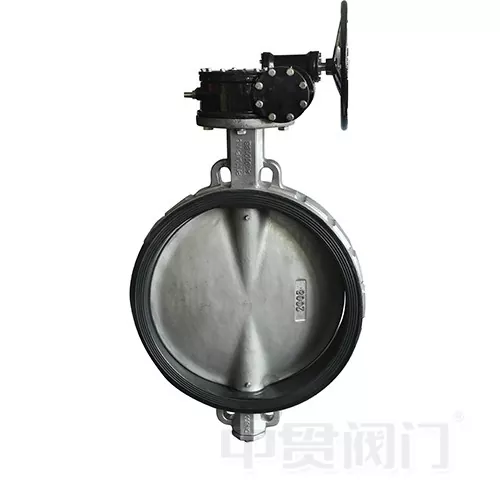
A High Performance Butterfly Valve addresses these issues through a double-offset construction and a resilient PTFE sealing system. Rather than relying on continuous rubbing contact, the disc follows a cam-like movement as it rotates. This allows the disc to move away from the seat shortly after opening and engage the seat primarily during the final stage of closing.
At Zhongguan Valve, we consider the interaction between disc geometry and seat material essential to sealing performance. The double-offset structure reduces unnecessary friction, while the PTFE or reinforced PTFE seat provides a resilient sealing surface. Together, these features help maintain reliable shutoff and reduce premature seat deformation during repeated operation.
Our PTFE-seated butterfly valve is designed to achieve ANSI/FCI 70-2 Class VI shutoff performance under the specified testing conditions. This makes it suitable for applications where leakage control is particularly important, including chemical transfer lines, solvent processing systems, and industrial water treatment.
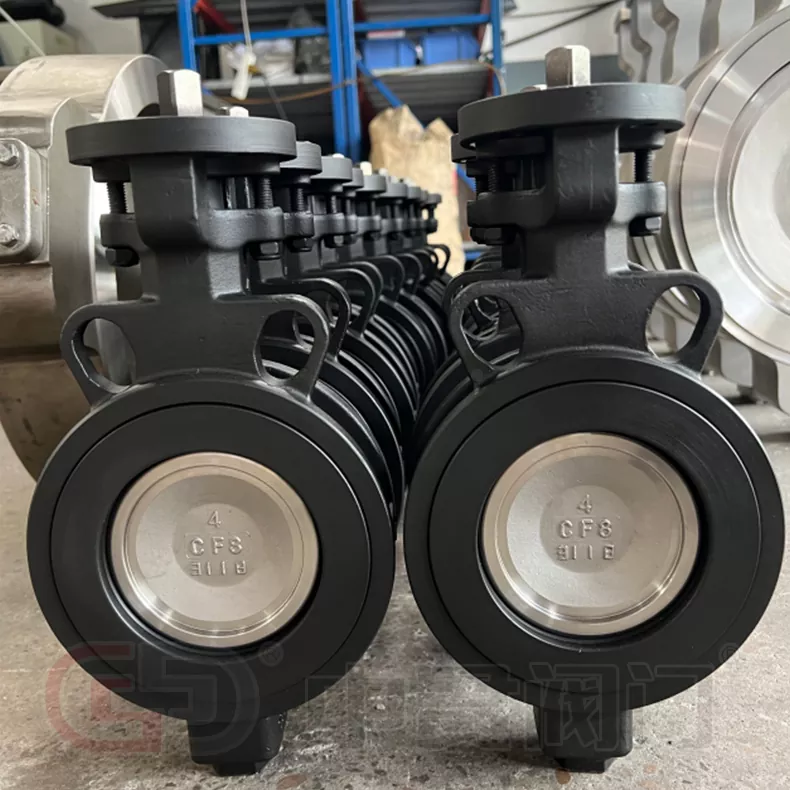
The double-offset design is one of the main structural differences between a high-performance butterfly valve and a conventional concentric model. It involves two shaft offsets: one from the sealing face centerline and another from the pipe centerline. These offsets change the movement path of the disc during operation.
When the valve begins to open, the eccentric shaft arrangement moves the disc away from the PTFE seat within the first few degrees of rotation. This reduces sliding contact between the disc edge and the sealing surface.
For pipelines with frequent operating cycles, reducing this contact is important. Excessive friction can gradually deform soft sealing materials and affect closing performance. The double-offset mechanism helps limit this wear and supports more consistent operation over repeated cycles.
Because the disc does not continuously rub against the seat, the valve generally requires less operating torque than a comparable concentric design. This can make actuator selection more economical, especially for larger valve sizes.
However, we do not recommend selecting an actuator based on nominal diameter alone. Actual torque requirements depend on differential pressure, medium characteristics, seat friction, and the required safety factor. For automated installations, these operating conditions should be confirmed before choosing a pneumatic or electric actuator.
The PTFE seat is designed to work with pipeline pressure rather than relying entirely on mechanical compression. Under suitable operating conditions, line pressure acts against the resilient seat and helps strengthen the contact between the disc and sealing surface.
This pressure-assisted sealing mechanism helps maintain tight shutoff across varying line pressures. Nevertheless, the final sealing result also depends on seat material selection, disc condition, installation accuracy, and the valve's specified pressure rating.
The sealing material directly affects how a butterfly valve performs when handling different fluids. Zhongguan Valve offers pure PTFE and reinforced PTFE (RTFE) seat options for its high-performance butterfly valve range.
PTFE is widely used in industrial sealing applications because of its chemical resistance and low coefficient of friction. Compared with many conventional elastomeric sealing materials, it offers better compatibility with a range of aggressive chemical media, although actual compatibility must always be checked against the specific fluid, concentration, and operating temperature.
| Performance Factor | PTFE / RTFE Characteristics | Practical Benefit |
|---|---|---|
| Chemical Resistance | Resistant to many acids, alkalis, solvents, and organic fluids | Suitable for various chemical processing pipelines |
| Friction Coefficient | Low-friction sealing surface | Reduces disc-seat friction during operation |
| Temperature Range | -40°C to 200°C for the specified valve configuration | Supports a broad range of industrial operating conditions |
| Sealing Performance | Designed for ANSI/FCI 70-2 Class VI shutoff | Supports applications requiring tight leakage control |
| Seat Options | Pure PTFE and Reinforced PTFE (RTFE) | Allows material selection according to project conditions |
Pure PTFE is commonly considered when chemical compatibility and a low-friction sealing surface are the main priorities. Reinforced PTFE incorporates reinforcing materials to improve certain mechanical properties, making it an alternative for applications where seat deformation resistance is an important consideration.
The correct choice should not be based on material names alone. We recommend checking the working temperature, pressure, fluid composition, and operating frequency before confirming the seat specification. For specialized projects, Zhongguan Valve can discuss the appropriate seat configuration according to the actual service conditions.
When evaluating sealing performance, engineers should also consider the valve's pressure rating, body construction, connection type, and operating temperature. These parameters determine whether the selected valve can match the pipeline design and operating requirements.
The following table summarizes the main specifications of our High Performance Butterfly Valve with PTFE Seat.
| Parameter | Standard Specification | Optional Configuration |
|---|---|---|
| Nominal Diameter | DN40–DN1600 (1.5"–64") | Larger sizes upon request |
| Body and Disc Material | Alloy Steel / Cast Steel WCB | CF8 (304), CF8M (316), Duplex |
| Seat Material | Pure PTFE / Reinforced PTFE (RTFE) | Fire-safe seat with PTFE and metal ring |
| Operating Temperature | -40°C to 200°C | High-temperature RTFE modifications |
| Pressure Rating | PN10–PN40 / Class 150–300 | Up to Class 600 subject to verification |
| Operation | Manual Lever / Worm Gear | Pneumatic / Electric Actuator |
| End Connection | Wafer / Lug / Flanged / U-Section | Butt-Weld upon request |
| Design Standards | API 609 / ANSI B16.34 / GB/T 12238 | Additional project-specific requirements |
The specifications above cover the available product configurations. Not every material, size, pressure rating, or seat option is necessarily available in every combination. We recommend confirming the final configuration with our technical team before production.
Even a well-designed butterfly valve can experience sealing problems if the operating conditions or installation details are not properly considered. In our experience, the following factors deserve particular attention during valve selection and pipeline commissioning.
The pressure difference across the disc affects the force required to operate the valve and the loading conditions on the sealing components. A valve rated for PN16, for example, should not automatically be assumed suitable for every application with a nominal pressure close to that value. The actual working pressure, temperature, and applicable pressure-temperature rating must be checked together.
PTFE offers broad chemical resistance, but no single sealing material should be treated as universally compatible. Chemical concentration, temperature, fluid composition, and potential contamination can influence material selection.
For chemical processing applications, we recommend providing the exact medium and its operating conditions before confirming the seat material.
Incorrect installation can create uneven loading on the disc and seat. Before commissioning, engineers should verify the flange alignment, gasket position, bolt tightening sequence, and available disc clearance.
Our valves can generally be installed in horizontal or vertical pipelines. A horizontal stem arrangement is preferred where practical to help distribute seat loading evenly. The final installation orientation should also consider actuator accessibility and maintenance clearance.
An undersized actuator may fail to provide sufficient torque for reliable operation, while excessive torque can place unnecessary stress on valve components. For automated systems, actuator sizing should account for differential pressure, seat friction, operating frequency, and the required safety margin.
These factors are particularly important in large-diameter pipelines and systems where valves operate frequently.
The combination of double-offset disc movement and PTFE sealing makes this valve configuration suitable for several industrial fluid-control applications. At Zhongguan Valve, we focus on matching valve construction and material options to the actual service conditions rather than treating every pipeline application in the same way.
Chemical plants often handle acids, alkalis, solvents, and other process fluids that require careful sealing material selection. PTFE-seated butterfly valves can be used in suitable chemical transfer lines, solvent recovery systems, and process distribution networks where chemical compatibility and tight shutoff are required.
In water treatment facilities and power plants, butterfly valves are used in demineralized water lines, auxiliary cooling circuits, and industrial water distribution systems. Body material, pressure rating, and seat configuration should be selected according to water quality, temperature, and operating pressure.
Industrial facilities use butterfly valves to control cooling water, process gases, and wastewater treatment lines. Their compact construction and different connection options make them practical for installations where available pipeline space and maintenance access are important considerations.
Marine applications include ballast systems, seawater cooling circuits, and auxiliary utility pipelines. For these environments, engineers should pay particular attention to body and disc material selection, corrosion exposure, pressure requirements, and the compatibility of all wetted components.
Butterfly valves are also used in hot water distribution, municipal water supply, and chilled-water circulation systems. For these applications, operating temperature, pressure loss, valve size, and actuator configuration all contribute to overall system performance.
Choosing a valve involves more than comparing nominal diameter and purchase price. A suitable configuration should match the fluid characteristics, pipeline design, operating conditions, and maintenance requirements.
When reviewing a project specification, our technical team at Zhongguan Valve generally focuses on the following information:
| Selection Item | Information to Confirm | Why It Matters |
|---|---|---|
| Fluid Medium | Fluid name, concentration, and characteristics | Determines seat and body material compatibility |
| Nominal Size | DN or NPS | Ensures compatibility with pipeline dimensions |
| Operating Pressure | Normal and maximum differential pressure | Determines pressure rating and actuator requirements |
| Temperature | Normal and maximum working temperature | Helps verify the seat material's operating limits |
| Connection Type | Wafer, lug, flanged, or U-section | Ensures correct pipeline installation |
| Operation Method | Manual, pneumatic, or electric | Determines the required operating torque and control arrangement |
| Sealing Requirement | Required leakage class and test conditions | Confirms the required shutoff performance |
As a professional butterfly valve manufacturer located in Yongjia, Wenzhou, Zhejiang, China, Zhongguan Valve has more than 10 years of experience in butterfly valve production. Our product range covers wafer, lug, U-section, and flanged butterfly valve configurations, with nominal diameters from DN40 to DN1600.
We also provide technical consultation, dimensional verification, production updates, and pre-shipment quality inspections. Our manufacturing facilities use pressure testing machines, precision assembly equipment, and laser marking systems to support production and quality control.
For project-specific requirements, our team can review technical drawings, operating parameters, and connection dimensions before production. We also provide a 12-month product quality warranty under the stated warranty conditions.
The main difference is the disc and shaft geometry. A high-performance butterfly valve typically uses a double-offset structure that moves the disc away from the seat during opening, reducing friction and seat wear. A concentric butterfly valve has a centered shaft arrangement and maintains more continuous contact between the disc and seat during rotation.
Our PTFE-seated high-performance butterfly valve is designed to achieve ANSI/FCI 70-2 Class VI shutoff performance under the specified test conditions. Actual results depend on the valve configuration, seat condition, pressure, and proper installation. The applicable leakage classification and test requirements should be confirmed for each project.
The specified standard configuration operates from -40°C to 200°C. Optional high-temperature RTFE modifications may be considered for specialized applications. The final operating limit should be verified according to the selected seat material and pressure-temperature conditions.
Neither material is universally better. Pure PTFE offers broad chemical resistance and low friction, while reinforced PTFE is designed to improve certain mechanical properties. The selection should depend on the process medium, temperature, pressure, and mechanical loading conditions.
Our standard specifications include PN10 to PN40 and ASME Class 150 to Class 300. Higher pressure configurations, including up to Class 600, can be considered subject to engineering verification of the valve size, material, and operating conditions.
Yes. Our standard operation options include manual levers and worm gear operators, while pneumatic and electric actuation are available as optional configurations. Actuator selection should be based on the required operating torque, differential pressure, and control requirements.
We recommend preparing the nominal diameter, working pressure, operating temperature, fluid medium, connection type, and preferred operation method. If the application involves corrosive chemicals or special sealing requirements, providing the fluid concentration and required leakage class will also help our technical team evaluate the appropriate configuration.
Sealing performance in a high-performance butterfly valve depends on more than the material of the seat. The double-offset structure reduces disc-seat friction, while the PTFE or RTFE sealing surface provides chemical resistance and supports tight shutoff under suitable operating conditions. Pressure rating, temperature, installation, and actuator sizing also play important roles in long-term performance.
At Zhongguan Valve, we combine butterfly valve manufacturing experience with different body materials, seat configurations, connection types, and operating options to meet varied industrial requirements. Whether the application involves chemical processing, water treatment, power generation, or industrial utilities, selecting the correct valve configuration is the first step toward reliable pipeline operation.
If you are evaluating a High Performance Butterfly Valve for an upcoming project, contact Zhongguan Valve with your DN size, medium, working pressure, and temperature requirements. Our team can help review the technical configuration and provide relevant product information.
-